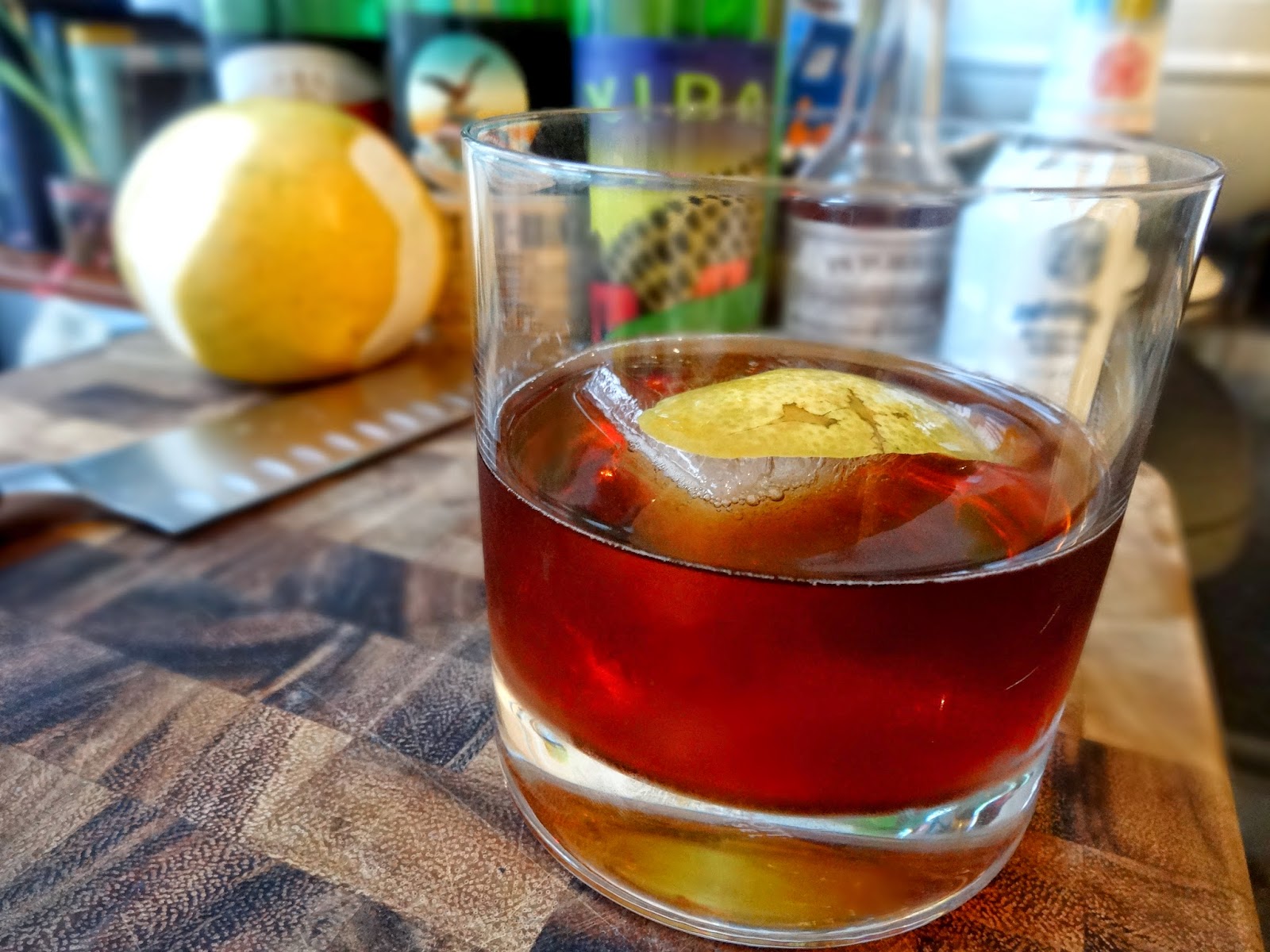
Showing posts with label Cocktail Recipes. Show all posts

Friday, July 18, 2014

Friday Cocktail: Champs-Élysées

And we're back!  I've been pretty delinquent in posting Friday cocktails here, and even more delinquent in food-related posts, but forget all that and make this drink.  Today's cocktail, the Champs-Élysées, is very similar to the Sidecar but uses Green Chartreuse for some added complexity (and kick), rather than Cointreau. This one manages to be both complex and refreshing at the same time, a perfect drink for the unusually cool July weather we've had this week.  Santé!

Champs-Élysées
Harry Craddock, The Savoy Cocktail Book (1930)

- 2 oz. Cognac (Pierre Ferrand Ambre)
- .5 oz. Green Chartreuse
- .75 oz. Lemon Juice
- .25 oz. Simple Syrup
- 1 dash Angostura Bitters

Combine ingredients in cocktail shaker with ice and shake vigorously.  Double strain into chilled coupe glass and garnish with lemon twist.

Friday, June 6, 2014

Friday Cocktail: The Diamondback


For the longest time, I resisted buying a bottle of Green Chartreuse. Although it appears in a ton of classic and contemporary cocktails, I just couldn't justify spending $60 on a bottle of liqueur. I finally picked up a bottle this week, and I have been really impressed. 

Chartruese is an incredibly complex herbal liqueur that has been made by the Carthusian Monks near Grenoble, France since the early 18th century. The recipe is closely guarded, though it purportedly is aged with 130+ different herbs, flowers, and plants. It comes in two versions, Green and Yellow. Green Chartreuse is bolder and stronger at an eye popping 110 proof, while the Yellow Chartreuse is sweeter and milder at only 80 proof. 

This week, I've used my bottle of Green Chartreuse in a bunch of different cocktails, including the gin-based Bijou and the Irish whisky-based Tipperary.  My favorite so far has been the Diamondback. This drink dates back Ted Saucier's 1951 book Bottoms Up and packs a wallop. It uses bonded rye whiskey, bonded apple brandy, and Chartreuse.  Although the original recipe calls for the Yellow version, most resources I've consulted recommend the classic Green Chartreuse. If you are keeping score at home, that means that none of the ingredients in the Diamondback are under 100 proof, making this one to be sipped slowly and contemplated.

The Diamondback
Adapted from Ted Saucier, Bottom's Up, 1951

- 1.5 oz. Rittenhouse bonded rye
- .75 oz. Laird's bonded apple brandy
- .75 oz. Green Chartreuse

Combine over ice in a mixing glass and stire. Strain into a chilled coupe.  No garnish.

Friday, May 30, 2014

Friday Cocktail: The Jack Rose

Flipping through the excellent PDT Cocktail Book, I noticed that a lot of the recipes call for Laird's Bonded Apple Brandy. This product caught my eye because the label reads like a bourbon label in that it bears the "Bottled in Bond" designation.  This means that by law -- the Bottled in Bond Act of 1897 to be precise -- it must be aged in a bonded warehouse for at least four years and bottled at 100 proof. Although there are several bonded whiskies (Rittenhouse, Old Granddad, Col. E.H. Taylor), this is the only brandy I'm aware of bearing the designation. Unlike the French Calvados I've had, the Laird's is drier than expected with only a hint of apples. It could almost pass for whiskey. In any event, the stuff works great in cocktails and is a steal at $25. 

My new bottle of Laird's Bonded called for the most classic apple brandy cocktail, the Jack Rose. This recipe dates back to Boothby's 1908 book, The World's Drinks and How to Mix Them. The 100 proof Laird's is essential here, as the drink is diluted considerably with the grenadine and lemon juice. About the grenadine, if you can't make your own, try to spring for the good stuff. Jack Rudy Cocktail Co. makes a great one (the bottle even has a recipe for the Jack Rose on the side), and I'm sure there are others. The stuff you'll find at the grocery store won't do. For the citrus juice, I go with lemon juice, though some recipes call for lime.

Jack Rose
William Boothby, The World's Drinks and How to Mix Them
Adapted from the PDT Cocktail Book

- 2 oz. Laird's Bonded Apple Brandy
- .75 oz. Lemon Juice
- .75 oz. Jack Rudy Small Batch Grenadine

Combine in a cocktail shaker with ice. Shake vigorously and strain into a chilled coupe. No garnish.

Friday, May 23, 2014

Friday Cocktail: The Sidecar

For me, the quintessential brandy cocktail is the Sidecar. Dating back to the 1920s, there are two schools of thought about the correct proportions for the cognac, Cointreau, and lemon juice. The original drink was made with equal parts of each ingredient (1:1:1), in what is known as the "French School" style. I prefer the "English School" variation, which appears in the Savoy Cocktail Book (1930). This version uses a 2:1:1 ratio -- two parts cognac and 1 part each of the Cointreau and lemon juice. Some recipes call for sugar along the rim of the glass. Please don't do that.

The Sidecar
As modified in the Savoy Cocktail Book, 1930

- 1.5 oz. Cognac (Pierre Ferrand or Léopold Gourmel work well)
- .75 oz. Cointreau* 
- .75 oz. lemon juice

Pour all three ingredients into a cocktail shaker filled with ice. Shake vigorously and strain into a chilled coupe. No garnish.

*For a drier cocktail, use Pierre Ferrand Dry Curaçao

Thursday, May 8, 2014

Friday Cocktail: Bufala Negra


Today's cocktail comes to us from Atlanta's own Jerry Slater of H. Harper Station. The Bufala Negra is light and refreshing drink thanks to the addition of ginger beer but picks up a lot of depth from the muddled basil and balsamic syrup. I used real-deal 12 year old balsamic I brought back from Italy, which is totally unnecessary for this drink but worked spectacularly. 

Bufala Negra
Jerry Slater, H. Harper Station, Atlanta

- 1.5 oz. bourbon (I used Old Grand Dad 114)
- 4 fresh basil leaves
- 1 brown sugar cube
- 0.5 oz. balsamic syrup*
- 2 oz. ginger beer

Muddle the balsamic syrup, basil, and sugar cube in a mixing tin. Add bourbon and ice and shake vigorously. Strain over fresh ice cubes into an Old Fashioned glass. Top with ginger beer and garnish with basil leaf.

*For the balsamic syrup, combine equal parts balsamic vinegar and 1:1 simple syrup and bring to a boil. Turn off heat and let cool completely.

Wednesday, April 30, 2014

The Well-Made Mint Julep


The mint julep still lives, but it is by no means fashionable. Somehow the idea has gotten abroad that the mint ought to be crushed and shaken up with water and whiskey in equal proportions. No man can fall in love with such a mixture. Poor juleps have ruined the reputation of the South’s most famous drink.
- Georgia newspaper, 1860s
As I prepare to leave for my annual Kentucky Derby trip, it seems fitting to do a post on juleps. A properly made mint julep is a thing to behold: ice cold, boozy and fragrant. A poorly made julep, however, is disgustingly sweet. Ironically, Churchill Downs serves one of the worst offenders at the Derby, a pre-bottled Early Times julep. It's not their fault, I suppose. You can't make that many mint juleps to order. But at home, you can experience the full potential of this great drink.

Most don't realize that a julep can be made with anything but bourbon, yet prior to the Civil War, genteel Southerners drank their juleps with brandy. Both versions are incredibly refreshing on a hot day. Whatever the base spirit used, there are a few rules to making a well-made julep.
  • Use good bourbon (or brandy). The base spirit is the star of this drink, so use the good stuff.
  • Do not over-muddle the mint. Doing so releases bitter chlorophyll in addition to the fragrant oils.
  • Use a proper vessel. A silver julep cup is preferable, but any metal cup will work.
  • Use the highest proof spirit you can find.  The drink has a lot of ice and will dilute quickly. For bourbon, I recommend high rye and high proof.  Four Roses Single Barrel and Old Grand Dad 114 are my personal favorites.
  • Go easy on the simple syrup. You can always add more.
  • Smash the ever-loving sh*t out of your ice. Either get a Lewis bag or use a kitchen towel and pulverize the ice with a mallet or rolling pin.  You are looking for ice that resembles gravel.
  • Slap a bunch of fresh mint to use for garnish.  The aroma this creates adds tremendously to the drink.
Now, some recipes.


The Classic Bourbon Mint Julep

- 10 mint leaves
- .25 to .5 oz. strong simple syrup (2:1 ratio)
- 3 oz. high rye, high proof bourbon*
- Mint sprig to garnish
Put the mint and simple syrup into the julep cup and lightly muddle the mint with the back of a bar spoon. 5 seconds should be sufficient. Add bourbon and fill with crushed ice. Stir the drink to combine and add more ice. Slap mint sprig and stick into drink for garnish and aroma.
*For a brandy julep, simply substitute good cognac for the bourbon.

The Georgia Mint Julep
Adapted from Professor Jerry Thomas (1862)*


- 10 mint leaves
- 2 oz. Cognac (I prefer Léopold Gourmel VSOP)
- 1 oz. Combier Pêche de Vigne 
- Mint sprig to garnish
Put the Combier peach liqueur into the julep cup with the mint leaves and lightly muddle the mint with the back of a bar spoon. Add the cognac and fill the cup with ice. Stir to combine and top with more ice and a mint sprig.


*Professor Jerry Thomas's recipe from the classic Bar-tenders Guide, Or How To Mix Drinks (1862) calls for peach brandy.  Unfortunately, there are no quality peach brandies in existence, as far as I'm aware. As a result, I prefer to substitute high quality peach liqueur (which contains a lot of sugar) and omit the sugar completely, which yields a superior drink.

And finally, the greatest tutorial (and history lesson) in the known world for making juleps by bartender extraordinaire Chris McMillan, along with a recitation of poetry by Kentucky writer Joshua Soule Smith.


Happy Derby!

Friday, April 25, 2014

Friday Cocktail: the Doctor Cocktail


The classic Doctor Cocktail is all about showcasing the hard to describe yet impossible to mistake "hogo" flavor present in some rums. The word "hogo" is derived from the French term "haut gaut" (translated "high taste") which was an 18th century term used to describe the funky flavor of wild game that had been hung to age. In the rum world, hogo is used to describe the funky and slightly sulphury quality that can be present in alcohol distilled from sugar. Pirates were assuredly drinking rum chock full of hogo, but most modern rum producers have figured out ways to minimize or eliminate hogo from their products. Rum and cocktail enthusiasts, however, have embraced hogo in the same way that scotch lovers covet medicinal flavors and cognac drinkers seek out "rancio."  And, when a rum with hogo is paired lime and sugar, the drink becomes pleasantly unique rather than overpowering.

The Doctor Cocktail employs two sources of hogo.  First, it uses super funky Jamaican rum.  On top of the rum, it uses uses Swedish Punsch, which is made with Batavia-Arack (an Asian liquor distilled from sugar cane and fermented rice) and flavored with rum, sugar and spices. The sugar from the punsch and lime juice make the good Doctor a very sippable drink, like a classic daiquiri turned up to 11. 

The Doctor Cocktail
Victor Bergeron (aka Trader Vic)*
As printed in Ted Haigh's Vintage Spirits and Forgotten Cocktails (2009)

- 2 oz. Jamaican Rum (I used Smith & Cross)
- 1 oz. Swedish Punsch (I used Kronan)
- 1 oz. Fresh Lime Juice

Add ingredients to cocktail shaker full of ice. Shake vigorously and strain into chilled coupe glass. Garnish with lime twist.

*Although I like the above recipe the best, there are several other variations. Here are a couple of them:
- Frank Meier (Artistry of Mixing Drinks, 1936) - equal parts rum and punsch with a teaspoon each of orange and lemon juices. 
- Harry McElhone (Bar Flies & Cocktails, 1927) - equal parts punsch, limejuice and lemon juice.

Friday, April 18, 2014

Friday Cocktail: Paper Airplane


I love the Paper Airplane for a lot of reasons. It is a tart and refreshing bourbon cocktail that uses one of my favorite amari called Amaro Nonino.  The Nonino has a silky grappa base (not typical) that is flavored with orange peel and saffron among a host of other flavorings, and aged in French oak for five years (not typical). The recipe is also easy to remember on the fly because it contains equal parts of its four ingredients.

The Paper Airplane is actually an adaptation of the Paper Plane, which uses the more subtle Aperol over the Campari. I like both versions but tend to have Campari on hand more often.

Paper Airplane
(Adapted by Toby Maloney, Violet Hour, Chicago, Illinois)

- 3/4 oz. Bourbon (I used Beam Signature)
- 3/4 oz. Amaro Nonino
- 3/4 oz. Campari
- 3/4 oz. Lemon Juice

Combine ingredients in a cocktail shake and add ice. Shake vigorously for 15 seconds and strain into chilled cocktail glass. No garnish.

Friday, April 11, 2014

Friday Cocktail: The McQueen

My Mezcal cocktail kick continues. Not content with one smoky spirit in this drink, John McCarthy of the now defunct New York cocktail spot Mary Queen of Scots also uses the incredibly smoky Ardbeg 10 year to rinse the glass. Yet, the sweeter Speyside single malt and agave syrup keep the smoke in check and make this a very drinkable cocktail. Though the McQueen isn't for everyone, anyone that isn't scared of smoky spirits will love it. 

The McQueen 
(aka the "Smoky Smoke Smoke")
John McCarthy, Mary Queen of Scots (New York, NY)

Ingredients
- 1 oz. Mezcal (Del Maguey Vida)
- 1 oz. Speyside Scotch (Balvenie 14 year Carribean Cask)
- .5 oz. Dark Agave Syrup*
- 1 dash Orange Bitters
- 1 dash Bittermens Xocolatl Mole Bitters
- Ardbeg 10 year Scotch to rinse
- Grapefruit twist to garnish 

Stir mezcal, Scotch, agave syrup, and bitters in a mixing glass with ice. Mist or rinse coupe glass with Ardbeg 10yr. Strain into misted coupe. Squeeze and flame grapefruit twist.

*To make the agave syrup, mix equal parts dark agave nectar and warm water in a squeeze bottle. Shake to combine.

Friday, April 4, 2014

Friday Cocktail: Dia Del Muerto


I have been on a huge mezcal kick recently. It's an agave spirit like tequila but has an intense smoky flavor due to the agave being roasted over rocks prior to distillation. Basically, mezcal is to tequila as peated Islay scotch is to unpeated mainland scotch. Because of its smoky minerality, mezcal stands in for whiskey in numerous cocktail riffs, like the excellent Oaxaca Old Fashioned. Tequila cocktails, on the other hand, are often citrus based drinks that, while good, end up tasting like variations of the Margarita.

Today's cocktail was created by Atlanta bartender Brad Tolleson, who took over for Paul Calvert at Pura Vida before it closed and is now at Restaurant Eugene. The Dia Del Muerto pairs Mezcal with bitter Italian amari and spicy Punt e Mes vermouth. It is a bit of a Negroni variant in this way. The addition of agave syrup provides balance for the mezcal and amari. Tolleson designed this drink to stand up to Pura Vida's pork and beef dishes. This drink is great for whiskey drinkers.


Dia Del Muerto
Brad Tolleson (Atlanta, Georgia)

- 1.5 oz. Mezcal (Del Maguey Vida)
- .5 oz. Fernet-Branca
- .5 oz. Punt e Mes
- .25 oz. Amaro Montenegro*
- .25 oz. agave syrup**
- 1 dash Angostura Bitters
- 1 dash Peychaud's Bitters

Combine ingredients in cocktail shaker and add ice. Stir and strain into a rocks glass with a large ice cube. Garnish with grapefruit twist.

* I have also used Cynar in place of the Amaro Montenegro with very good results.

**To make the agave syrup, mix equal parts dark agave nectar and warm water in a squeeze bottle. Shake to combine.

Monday, March 24, 2014

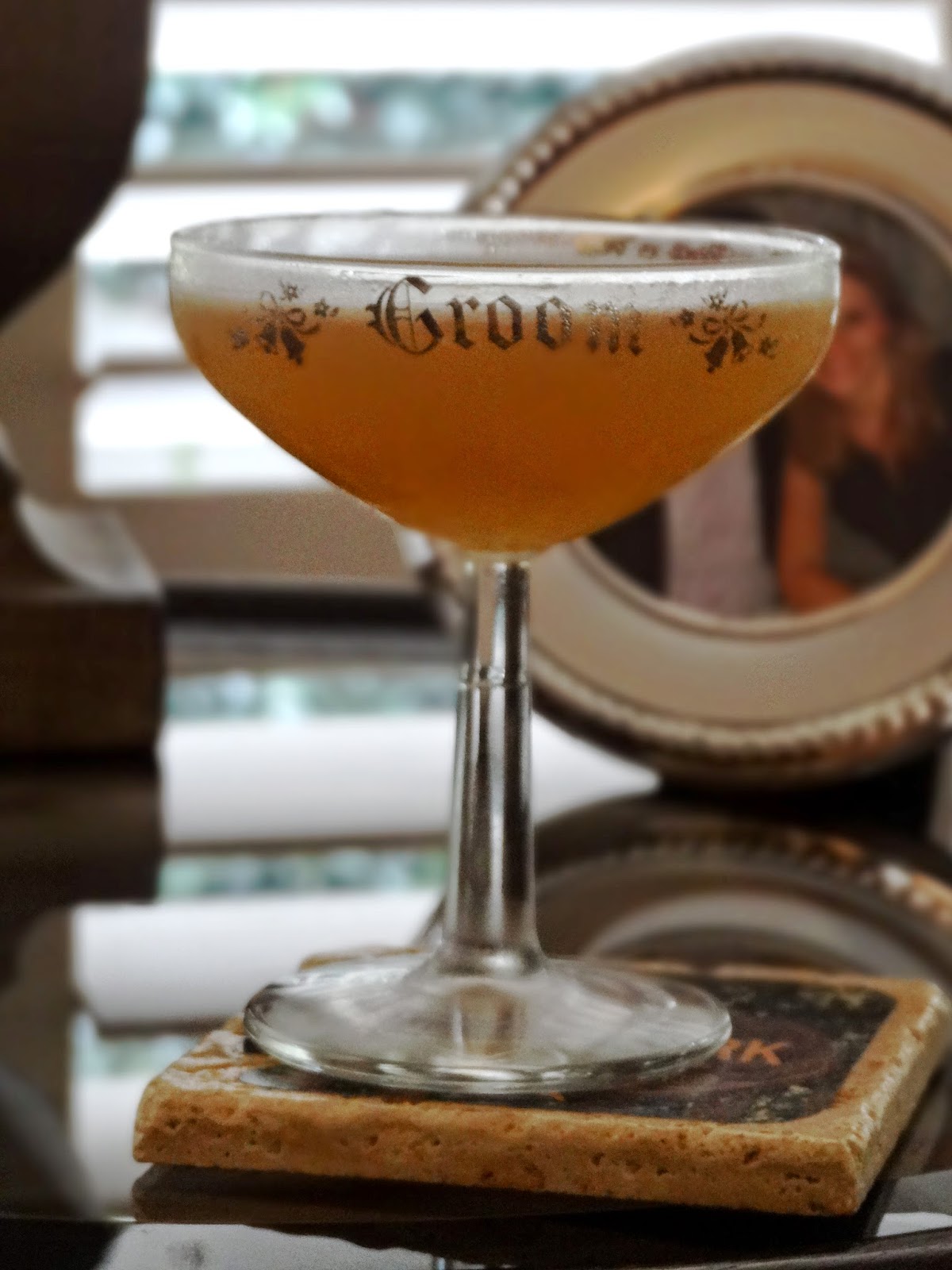
Goodbye Lillet, Hello Kina L'Avion D'Or


Kina L'Avion D'Or is a relatively new version of an old style of apértif known as a a quinquina (or kina, for short) released by Tempus Fugit Spirits, a company known for sourcing and creating historic products. The L'Avion D'Or -- or "Golden Airplane," in tribute to Louis Blériot's 1909 flight across the English Channel -- is absolutely fantastic on its own or in pretty much any cocktail that calls for Lillet, such as the Vesper or the Corpse Reviver No. 2 (see recipes below). You see, Kina Lillet, as it was known until 1986, contained far more quinine than the sweeter, less bitter Lillet Blanc that exists today. Kina L'Avion D'Or is now thought by many to have replaced Cocchi Americano as the closest thing we have to Kina Lillet. I can't speak to that, as I haven't tasted the old Kina Lillet, but I do find that that L'Avion D'Or makes a much more interesting cocktail than the current Lillet Blanc. (Shoutout to the nice folks at H&F Bottle Shop for turning me onto this stuff.)

The history of quinquina is one of pragmatism. As with many alcoholic products, kinas were developed for medicinal reasons. In the first half of the 19th century, malaria was a major problem for French soldiers and colonists in North Africa. The primary treatment was quinine, which was extracted from the bark of the South American cinchona tree. Apparently, quinine was so bitter that nobody could get it down, so the French started creating fortified wines containing quinine to make it more palatable. (The British started drinking gin and tonic, which also contains quinine, in colonial India for the same reasons.) So, as with so many other things, quinquina started out as medicine and proliferated to the larger drinking culture.

In France, these apéritif wines are drunk by themselves or over ice with soda water and a slice of citrus, which makes perfect sense as a pre-dinner apéritif. Made with Cortese grape white wine infused with cinchona, orange peel, wormwood, and other spices, the Kina L'Avion D'Or is full of flavor and nuance but without the alcohol punch of a strong cocktail that might make you forget to make dinner. 

The L'Avion D'Or also takes cocktails -- especially gin cocktails -- to another level. Pretty much any recipe that calls for Lillet can be improved with this stuff. It can also act as a bolder and more interesting stand-in for dry vermouth. I'm also itching to try this in a white (er, yellow?) negroni. Store this product as you would vermouth. With an alcohol content of only 18%, it should be kept in the fridge and drunk within 4-6 weeks.

Here are two adaptations of classic cocktails that showcase the L'Avion D'Or.

Corpse Reviver No. 2
Adapted from the Savoy Cocktail Book (1930)

"Four of these taken in swift succession will 
unrevive the corpse again" - Harry Craddock
- 1 oz. Gin
- 1 oz. Cointreau (I used Pierre Ferrand Dry Orange Curaçao)
- 1 oz. Kina L'Avion D'Or (in place of the Lillet Blanc)
- 1 oz. Lemon Juice
- 1-3 Dashes of Absinthe (I used St. George)

Combine ingredients in cocktail shaker and add ice. Shake and double strain into a coupe. Garnish with Luxardo Maraschino cherry.

Vesper
Invented by James Bond in Ian Fleming's Casino Royale (1953)
Adapted by H&F Bottle Shop
"I never have more than one drink before dinner. But I do like that one to be large and very strong and very cold and very well-made. I hate small portions of anything, particularly when they taste bad. This drink's my own invention. I'm going to patent it when I can think of a good name." - James Bond in Casino Royale, Ch. 7 ("Rouge et Noir")

- 1.5 oz. Beefeater Gin (I used Plymouth)
- 1 oz. Sobieski Vodka (I used Cathead)
- .5 oz. Kina L'Avion D'Or (in place of the Kina Lillet)

Combine ingredients in cocktail shaker and add ice. Shake and strain into chilled martini glass.  Garnish with lemon twist.

*Note - If you want to stay true to the Bond version, use "three measures of Gordon's [gin], one of vodka, half a measure of Kina Lillet. Shake it very well until it's ice-cold, then add a large thin slice of lemon peel."
Friday, March 21, 2014

Friday Cocktail: The Reengineered Bourbon and Coke

It is your favorite drink from college, all grown up. Featured recently in Garden & Gun, the Reengineered Bourbon and Coke has all of the familiar flavors of the classic, but correctly proportioned. A sweeter wheated bourbon with some wood influence works best here. The recipe calls for Makers 46, but Weller 12 would also do nicely. The Coca-Cola syrup is ridiculously easy to make and keeps nicely in the fridge, and using only a quarter ounce of syrup keeps this drink from being overly sweet. 

This cocktail is probably too fussy to make at a tailgate (or to sneak into a football game), but it will do just fine for the NCAA tournament games on TV this weekend.

Reengineered Bourbon and Coke
Adapted from Garden & Gun and Stephen Dennison

Ingredients
For the syrup:
- 1/4 cup cane sugar Coca-Cola 
- 1/4 cup sugar (caster sugar works best)

For the cocktail:
- 2 oz. Makers 46 or other wheated bourbon
- 1/4 oz. Coca-Cola Syrup
- 2 dashes Angostura Bitters
- Lemon twist (or Maraschino cherry) to garnish

Preparation
For the syrup, put the Coke and sugar in a small saucepan over low heat.  Stir until dissolved. Cool and refrigerate.

For the cocktail, combine the bourbon, syrup, and bitters into a cocktail shaker with ice. Stir for 30 seconds (G&G says to shake but this turns the cocktail cloudy) and strain into a cocktail glass.  Garnish with lemon peel or cherry and serve.

Friday, March 7, 2014

Friday Cocktail: The Kirkwood

Today's cocktail, the Kirkwood, is a variation on the Red Hook that was created by Atlanta's own Miles Macquarrie, formerly of Leon's Full Service and now at the uber popular Kimball House.

The Red Hook (named after a Brooklyn neighborhood) is part of a series of derivative cocktail riffs based on the Manhattan and was named one of the 25 most influential cocktails of the past century by Imbibe magazine in 2010. For the Red Hook, Milk & Honey's Vincenzzo Errico replaces the Manhattan's sweet vermouth with the spicier Punt e Mes vermouth and adds Maraschino liqueur.  For Macquarrie's variation named after the the great East Atlanta neighborhood, he replaces the Red Hook's Maraschino with the bitter and herbal Cynar and adds St. Germain elderflower liqueur and grapefruit bitters for brightness. 

A fantastic cocktail worthy of a great Atlanta neighborhood.

The Kirkwood

- 1.5 oz. Rittenhouse Rye (or other high proof rye)
- .5 oz. Punt e Mes 
- .5 oz. Cynar
- .5 oz St. Germain
- 2 dashes grapefruit bitters

Combine all ingredients in a mixing glass with ice. Stir 30 seconds and strain into a cocktail glass. Garnish with grapefruit peel.

Friday, February 28, 2014

Friday Cocktail: La Louisiane

First published in Stanley Arthur's 1937 classic Famous New Orleans Drinks and How to Mix 'Em, the Cocktail á la Louisiane is more obscure than other New Orleans classics, though no less delicious. Think of it as a cross between a Manhattan, a Sazerac, and a Vieux Carré. Perfect for Mardi Gras. 

Cheers!

Cocktail á la Louisiane


Ingredients:
- 1 oz. Rittenhouse Rye*
- 1 oz. Carpano Antica Sweet Vermouth*
- 1 oz. Benedictine*
- 3 dashes Peychaud's Bitters
- 3-4 dashes Herbsaint (or Absinthe)


Fill a mixing glass with ice and add the rye, vermouth, Benedictine, Peychaud's and Herbsaint.  Stir 30 seconds and strain into a cocktail glass. Garnish with Luxardo Maraschino cherry.

*The original recipe calls for .75 oz. each of the Rye, Vermouth, and Benedictine, but that makes a very small cocktail.